
The Quick Read
- New York has no broad privacy law that orders every website to post a privacy policy. The state says so itself.
- Most small sites still need one. Google Analytics requires it in its terms, California law reaches sites that collect details from California residents, and whatever your site says about privacy has to be true.
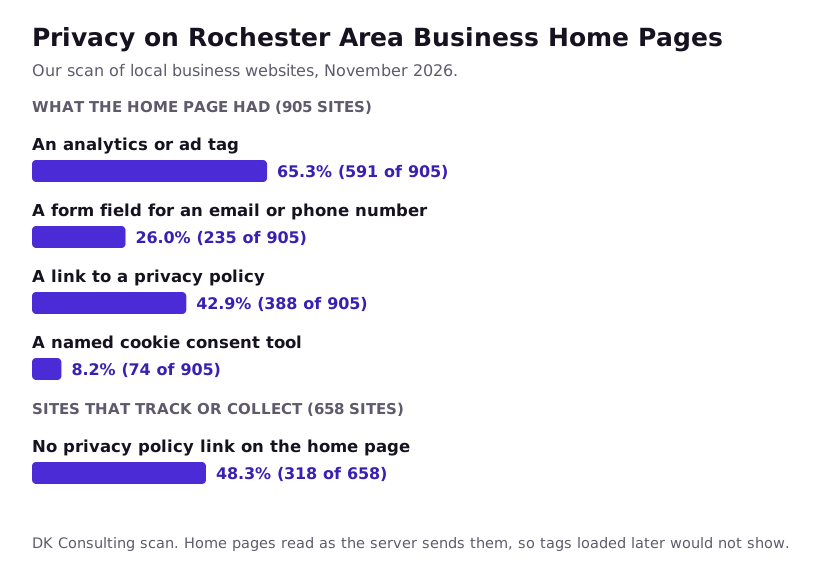
- We scanned 905 Rochester area business websites. 591 ran an analytics or ad tag on the home page. Only 388 linked a privacy policy there.
- Of 432 sites that loaded Google Analytics, 224 showed no privacy policy link on the home page.
- A cookie banner is not required in New York. If you add one, the decline button has to work.
Want DK Consulting first in Google? Set us as a preferred source
The New York Attorney General keeps an office at 144 Exchange Boulevard in downtown Rochester. It covers Monroe, Livingston, Ontario, Seneca, Steuben, Wayne and Yates counties.1 That office matters to anyone with a website. New York has no broad privacy law, and the Attorney General polices privacy promises anyway.
The state says so itself. In a guide for businesses last updated July 15, 2024, the Attorney General wrote that New York has no comprehensive privacy law that regulates online tracking.2
The same guide then explains what the office did anyway. It tested the privacy controls on busy websites and found 13 where they did not work as described. Those sites drew an estimated 75 million visitors in March 2024.2
So does a website need a privacy policy in New York? No state law orders every site to post one. Most small business sites still need one, for four reasons that have nothing to do with a privacy act. We also scanned 905 Rochester area websites to see who has one.
What New York Law Says Right Now
Start with what is not law. The New York Privacy Act, Senate Bill S3044, was sent back to the Internet and Technology Committee on January 7, 2026. It has not had a floor vote.3 The New York Health Information Privacy Act passed the Legislature and was vetoed in December 2025.4
Two things are law today.
The first is consumer protection law. The Attorney General says a business's privacy statements fall under New York's consumer protection laws, which bar deceptive acts and practices.2 Whatever your site says about privacy has to be true.
The second is the SHIELD Act, signed on July 25, 2019.5 It applies to any person or business that owns or licenses computerized data with private information of a New York resident, and it requires reasonable safeguards for that data.6
Private information has a set meaning. It is a name or other personal detail combined with a Social Security number, a driver's license number or a financial account or card number. It also covers a user name or email address combined with a password.7 A contact form that takes a name and a phone number is not on that list. A site with customer logins is.
Small businesses are not exempt. A business with fewer than 50 employees, less than $3 million in gross yearly revenue in each of the last three years, or less than $5 million in year end assets may fit its safeguards to its size.6 Failing to keep reasonable safeguards can cost up to $5,000 per violation.5 After a breach, affected New Yorkers must be told within thirty days of discovery.7
Then come the rules from outside New York. These are the ones that reach a Rochester site most often.
| Rule | Reaches a Small Rochester Site? | What It Asks |
|---|---|---|
| A broad New York privacy law | None in force | Nothing yet2 |
| New York consumer protection law | Yes | Privacy statements and controls must be true and must work2 |
| New York SHIELD Act | Yes, if you hold private information of New Yorkers | Reasonable safeguards, and breach notice within thirty days67 |
| California Online Privacy Protection Act | Yes, if the site collects personal details from California residents | A privacy policy posted conspicuously on the site8 |
| California Consumer Privacy Act | Rarely | Applies over $25 million in revenue, 100,000 California residents or households, or half of revenue from selling personal data9 |
| Google Analytics terms | Yes, if you run it | A posted privacy policy that gives notice of cookies and of Google Analytics10 |
| FTC Act | Yes | Live up to the privacy claims you make11 |
Two rows do most of the work. A Rochester bakery that ships cookies to San Diego collects details from a California resident. And nearly half the sites we scanned load Google Analytics, which makes the policy a term of the contract.
We are not lawyers, so take the legal side of your own case to one.
What We Found on 905 Rochester Websites
In November 2026 we scanned the home pages of 974 Rochester area businesses and organizations that each have a website on its own domain. 905 loaded. We read the code of each home page for three things. A link to a privacy policy, tags that track visitors, and form fields that ask for an email or a phone number.
| What the Home Page Had | Sites | Share |
|---|---|---|
| An analytics or ad tag | 591 of 905 | 65.3% |
| Google Analytics loaded on the page | 432 of 905 | 47.7% |
| An ad pixel, such as Meta or Google Ads | 141 of 905 | 15.6% |
| A form field for an email or phone number | 235 of 905 | 26.0% |
| A link to a privacy policy | 388 of 905 | 42.9% |
| A named cookie consent tool | 74 of 905 | 8.2% |
Two out of three sites track visitors. Fewer than half say anything about it.
The gap is clearest when the two columns meet. 658 sites had a tracking tag or a form that collects contact details. 318 of them, or 48.3 percent, had no privacy policy link on the home page.
The Google number stands out. Of the 432 sites that loaded Google Analytics, 224 showed no privacy policy link. Google's terms say every customer must post a privacy policy and that it must give notice of cookies.10 Those 224 owners agreed to that when the tag went on the site.
Ad pixels were no better. 61 of the 141 sites with an ad pixel had no policy link.
The split by trade was wide.
| Type of Business | Home Pages With a Privacy Policy Link | Share |
|---|---|---|
| Banks, insurance and finance | 29 of 38 | 76.3% |
| Real estate | 30 of 44 | 68.2% |
| Medical offices | 57 of 108 | 52.8% |
| Shops | 52 of 102 | 51.0% |
| Home improvement and repair | 33 of 77 | 42.9% |
| Salons, spas and fitness | 31 of 82 | 37.8% |
| Restaurants | 54 of 203 | 26.6% |
Finance leads, which fits. Banks and insurers already work under federal privacy rules.6 Restaurants trail. A restaurant site that takes orders or builds a mailing list collects as much as any shop.
A fair limit on these numbers. We read each home page as the server sent it. A policy linked only from a contact page would not count, and a tag loaded later by a tag manager would not show. The tag counts are a floor.
Privacy Policy vs Cookie Banner
These get mixed up. A privacy policy is a page that says what your site collects and who gets it. A cookie banner is a control that lets a visitor turn tracking off.
New York requires neither by name. But the Attorney General's guide is blunt about the banner. If you offer a control, it has to do what it says.
The office listed how the 13 sites went wrong. On seven of them, at least one tag was not sorted into the right category, so the off switch never reached it. Other sites had tags hardcoded into the page, where the consent tool could not touch them.2
One finding matters for every New York business. Meta and Google both offer settings that limit how visitor data gets used. The guide says those settings are often set to apply only in states with broad privacy laws. In other states, New York included, the tag provider may keep collecting data.2
The guide also says how a banner should look.2
- Use plain words, not legal terms.
- Label each button so its job is obvious.
- Make declining as easy as accepting.
- Do not use an X that could mean either answer.
- Make the controls work from a keyboard.
In our scan, 74 of 905 home pages loaded a named consent tool. That is 8.2 percent. For most small Rochester sites the first job is the policy, not the banner.
A banner you never tested is a promise you may not be keeping. Click decline on your own site, then check whether the tags still fire.

What a Small Business Privacy Policy Should Say
California's law gives the clearest list, and it works as a base for a New York site too. The policy should cover these points.8
- The kinds of personal details the site collects.
- The kinds of outside companies that may receive them.
- How a visitor can review or change their details, if you offer that.
- How you will announce changes to the policy.
- The date the policy took effect.
- How the site responds to a browser's do not track signal.
Add one line Google asks for. Say that the site uses Google Analytics and how it collects data.10
Then do the work in this order.
- List every tool on the site. Forms, booking, online ordering, analytics, ad pixels, chat and email signup.
- Remove the tags nobody uses. A pixel from an ad campaign that ended years ago still collects data.
- Write the policy to match the list. Name the tools. Keep it short.
- Link it in the footer of every page.
- Add a line under each form that says what you do with the details.
- If the site has customer logins, write down your safeguards. The SHIELD Act expects a named person in charge, staff training and vendors that can protect the data.5
- If you add a cookie banner, test the decline button every time you add a tag.
- Review the list twice a year. Sites pick up new tools without anyone updating the policy.
Step 2 is the one most owners skip. The best privacy fix on a small site is often deleting a tag, not adding a notice.
When we plan a site, the list of what it collects comes first. That is part of our web design for Rochester businesses. If accessibility is also on your mind, the New York ADA website checklist for small business covers that side of the law.
DK Consulting builds websites for small businesses in Rochester and across the US. We will scan your home page for tracking tags for free and tell you what we find. Ask for a free site review.
Odds and Ends
Does New York have a data privacy law?
Not a broad one. The Attorney General's own business guide says New York has no comprehensive privacy law that regulates online tracking.2 The New York Privacy Act is a bill that sits in a Senate committee.3 What New York does have is the SHIELD Act, which covers data security and breach notices, and consumer protection law, which covers what you promise.5
Do I need a privacy policy on my website?
If the site has a contact form, a booking tool, Google Analytics or an ad pixel, plan on yes. Google's terms tell every Analytics customer to post one.10 California's law covers any commercial site that collects personal details from California residents, wherever the business sits.8 A site with none of those things has far less to say, but a short policy still costs nothing.
Do I need a cookie banner in New York?
No New York law requires one. The catch is what happens if you add one anyway. The Attorney General found 13 busy websites where tags kept tracking visitors after they opted out, and treats a control that does not work as a possible deceptive practice.2 A banner that works is fine. A banner for show is worse than none.
Can I copy a privacy policy from another website?
It is a bad idea. A copied policy describes someone else's tools, not yours. In New York, privacy statements fall under consumer protection law, which bars deceptive acts.2 The FTC says the same thing at the federal level. If you make a privacy promise, you have to live up to it.11 Start from a list of what your own site collects.
Does the SHIELD Act apply to a business with five employees?
Yes, if it holds private information of New York residents. The law does not exempt small businesses. It lets a business with fewer than 50 employees, under $3 million in yearly revenue or under $5 million in assets size its safeguards to fit.6
Where should the privacy policy link go?
In the footer of every page, in plain words. California's law says the policy must be posted conspicuously.8 We also put a short line next to each form that says what happens to the details a visitor sends.
Notes and Links
- New York State Attorney General, Regional Offices, accessed November 2026
- New York State Attorney General, Website Privacy Controls, A Guide for Business, accessed November 2026
- New York State Senate, Bill S3044, the New York Privacy Act, accessed November 2026
- NYCLU statement on the veto of the New York Health Information Privacy Act, accessed November 2026
- New York State Attorney General, SHIELD Act, accessed November 2026
- New York General Business Law, Section 899-BB, Data Security Protections, accessed November 2026
- New York General Business Law, Section 899-AA, Notification of Breach, accessed November 2026
- California Business and Professions Code, Section 22575, via FindLaw, accessed November 2026
- California Attorney General, California Consumer Privacy Act, accessed November 2026
- Google Analytics Terms of Service, accessed November 2026
- Federal Trade Commission, Privacy and Security, accessed November 2026